2033 en astronomieÉclipse solaire
projets correspondantsocéan PacifiqueAlaskadétroit de Béringocéan Arctiquepôle Nord
Cet article est une ébauche concernant une éclipse.Vous pouvez partager vos connaissances en l’améliorant (comment ?) selon les recommandations des projets correspondants.
Éclipse solaire du 30 mars 2033
|
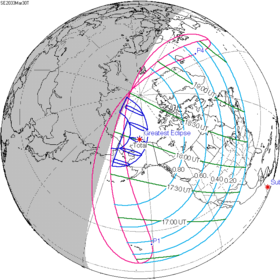
Carte de l'éclipse générale.
|
| Type d’éclipse |
|---|
Nature
|
Totale
|
|---|
Gamma
|
0,9778
|
|---|
Magnitude
|
1,0461
|
|---|
Saros
|
120 (62 sur 71)
|
|---|
| Éclipse maximum |
|---|
Durée
|
2 min 37,0 s
|
|---|
Localisation
|
Océan Arctique
|
|---|
Coordonnées |
71° 18′ 54″ nord, 155° 45′ 42″ ouest |
|---|
Largeur max. de la bande
|
780,7 km
|
|---|
| Circonstances générales (UTC) |
|---|
Éclipse partielle
|
de 15:59:17,7 à 20:02:43,1
|
|---|
Éclipse totale
|
de 17:35:34,0 à 18:26:17,3
|
|---|
Éclipse centrale
|
de 17:47:55,5 à 18:13:56,5
|
|---|
Maximum de l’éclipse
|
18:01:07,5
|
|---|
modifier  |
Une éclipse solaire totale aura lieu le 30 mars 2033.
Parcours |
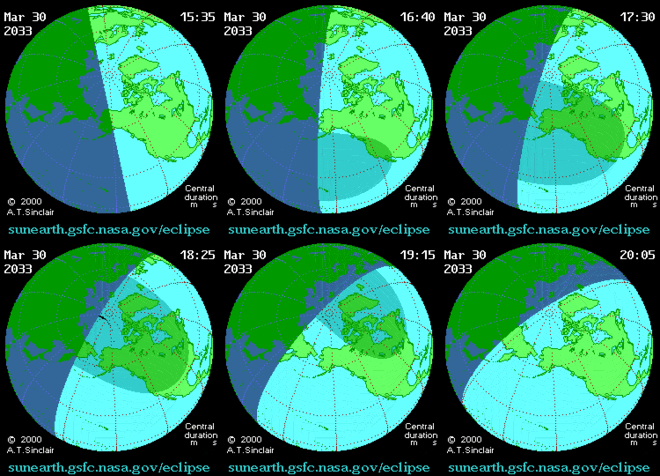
Carte animée de l'éclipse.
Cette éclipse totale commencera à l'extrême nord de l'océan Pacifique, décrira une boucle qui touchera en premier la côte ouest de l'Alaska, puis passera par le détroit de Béring que l'éclipse couvrira entièrement. Continuant vers le nord, l'éclipse quittera l'Alaska par la côte nord, elle aura son maximum pas loin de cette côte dans l'océan Arctique. Ensuite l'éclipse continuera sa boucle sur cet océan pour finir à environ 500 km du pôle Nord.
Liens externes |
(en) Carte de l'éclipse générale et informations sur l'éclipse Eclipse Predictions by Fred Espenak, NASA/GSFC
Éclipses solaires du XXIe siècle
|
|---|
| Totales/Hybrides |
.mw-parser-output .sep-listefont-weight:bold
2001 · 2002 · 2003 · 2005 · 2006 · 2008 · 2009 · 2010 · 2012 · 2013 · 2015 · 2016 · 2017 · 2019 · 2020 · 2021 · 2023 · 2024 · 2026 · 2027 · 2028 · 2030 · 2031 · 2033 · 2034 · 2035 · 2037 · 2038 · 2039 · 2041 · 2042 · 2043 · 2044 · 2045 · 2046 · 2048 · 2049 · 2050 · 2052 · 2053 · 2055 · Jan. 2057 · Déc. 2057 · 2059 · 2060 · 2061 · 2063 · 2064 · 2066 · 2067 · 2068 · 2070 · 2071 · 2072 · 2073 · 2075 · 2076 · 2077 · 2078 · 2079 · 2081 · 2082 · 2084 · 2086 · 2088 · 2089 · 2090 · 2091 · 2093 · 2094 · 2095 · 2096 · 2097 · 2099 · 2100
|
|
|---|
| Annulaires |
2001 · 2002 · 2003 · 2005 · 2006 · 2008 · 2009 · 2010 · 2012 · 2013 · 2014 · 2016 · 2017 · 2019 · 2020 · 2021 · 2023 · 2024 · 2026 · 2027 · 2028 · 2030 · 2031 · 2032 · 2034 · 2035 · Jan. 2038 · Juil. 2038 · 2039 · 2041 · 2042 · 2043 · 2044 · 2045 · 2046 · 2048 · 2049 · 2052 · 2053 · Jan. 2056 · Juil. 2056 · 2057 · 2059 · 2060 · 2061 · 2063 · 2064 · 2066 · 2067 · 2070 · 2071 · Jan. 2074 · Juil. 2074 · 2075 · 2077 · 2078 · 2079 · 2081 · 2082 · 2084 · Juin 2085 · Déc. 2085 · 2088 · 2089 · Fév. 2092 · Août 2092 · 2093 · 2095 · 2096 · 2097 · 2099 · 2100
|
|---|
| Partielles |
Avr. 2004 · Oct. 2004 · Mars 2007 · Sep. 2007 · Jan. 2011 · Juin 2011 · Juil. 2011 · Nov. 2011 · 2014 · 2015 · Fév. 2018 · Juil. 2018 · Août 2018 · 2019 · Avr. 2022 · Oct. 2022 · Mars 2025 · Sep. 2025 · Jan. 2029 · Juin 2029 · Juil. 2029 · 2032 · 2033 · Fév. 2036 · Juil. 2036 · Août 2036 · 2037 · Mai 2040 · Nov. 2040 · Jan. 2047 · Juin 2047 · Juil. 2047 · Déc. 2047 · 2050 · Avr. 2051 · Oct. 2051 · Mars 2054 · Août 2054 · Sep. 2054 · 2055 · Mai 2058 · Juin 2058 · Nov. 2058 · Mars 2062 · Sep. 2062 · Fév. 2065 · Juil. 2065 · Août 2065 · Déc. 2065 · 2068 · Avr. 2069 · Mai 2069 · Oct. 2069 · 2072 · 2073 · Juin 2076 · Juil. 2076 · Nov. 2076 · Fév. 2083 · Juil. 2083 · Août 2083 · 2084 · 2086 · Mai 2087 · Juin 2087 · Oct. 2087 · 2090 · 2091 · Juin 2094 · Juil. 2094 · Déc. 2094 · Avr. 2098 · Sep. 2098 · Oct. 2098
|
|---|
| Éclipses des autres siècles |
XXe siècle
|
|---|
 Portail de l’astronomie
  Portail du XXIe siècle


