Trouble du sommeilPneumologieSigne clinique en neurologie
apnéepression partiellesoxygènedioxyde de carbonesommeilsyndrome d'apnées du sommeilJohn CheyneWilliam Stokes

Le médecin John Cheyne (1777, 1836)
La respiration de Cheyne-Stokes (RCS) est un rythme respiratoire périodique anormal caractérisé par l'alternance régulière de périodes d'apnée et d'hyperpnée (respiration d'amplitude augmentée) : on note une augmentation progressive en crescendo du volume courant, suivie d'un decrescendo de la ventilation puis d'une apnée ou d'une hypopnée. Il s'agit d'un mécanisme compensatoire des modifications des pression partielles d'oxygène et de dioxyde de carbone.
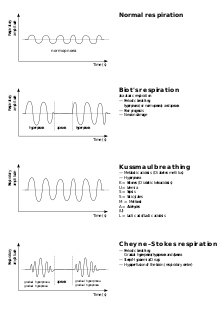
Diagramme de la respiration de Cheyne-Stokes et d'autres modes de respiration pathologiques.
Si la RCS ou une autre forme de respiration périodique surviennent au cours du sommeil, sans être dues à une lésion des centres respiratoires, il s'agit alors d'un syndrome d'apnées du sommeil de type central (SACS)[1].
La RCS doit son nom aux médecins irlandais John Cheyne (qui la décrivit en 1818) et William Stokes (qui en compléta la description en 1854).
Références |
↑ (en) Parveen Kumar et Michael Clark, Clinical Medicine. Sixth edition., Édimbourg, Elsevier Saunders, 2005, 6e éd., poche (ISBN 978-0-7020-2763-5, LCCN 2005044337), « 13 », p. 733
Troubles du sommeil
|
|---|
| Classification internationale des troubles du sommeil |
| Insomnies |
- Ajustement
- Psychophysiologique
- Paradoxale
- Idiopathique
- Secondaire à une maladie mentale
- Mauvaise hygiène du sommeil
- Secondaire à une drogue ou une substance
- Secondaire à une cause médicale
|
 |
|---|
| Respiration |
Syndrome d'apnées du sommeil (SAS)
- Syndrome d’apnées centrales du sommeil (SACS)
- Respiration de Cheyne-Stokes (RCS)
- Syndrome d’apnées obstructives du sommeil (SAOS)
- Syndrome de haute résistance des voies aériennes supérieures (SHRVAS)
Syndrome dhypoventilation du sommeil (SHS)
|
|---|
| Origine centrale |
- Narcolepsie
- Hypersomnie
Hypersomnie récurrente
- Hypersomnie idiopathique
|
|---|
| Rythme circadien |
- Syndrome de retard de phase
- Syndrome d’avance de phase
- Rythme veille-sommeil irrégulier
Syndrome hypernycthéméral (syndrome libre cours)
Syndrome du décalage horaire (jet lag)
- Travail posté
|
|---|
| Parasomnie |
Parasomnie par trouble de l'éveil en sommeil non REM
- Éveil confusionnel
- Somnambulisme
- Terreur nocturne
Parasomnie habituellement associées au sommeil REM
- Trouble du comportement en sommeil paradoxal
- Paralysie du sommeil
- Cauchemar
- Trouble dissociatif lié au sommeil
- Énurésie nocturne
- Catathrénie
- Syndrome de la tête qui explose
- Hallucinations liées au sommeil
- Trouble du comportement alimentaire lié au sommeil
|
|---|
| Mouvement |
- Syndrome des jambes sans repos
- Syndrome des mouvements périodiques du sommeil
- Crampes musculaires en relation avec le sommeil
- Bruxisme du sommeil
- Rythmie du sommeil
|
|---|
| Symptômes isolés |
- Long dormeur
- Court dormeur
- Ronflement
- Somniloquie
- Secousse hypnique
- Myoclonies bénignes de l’enfant
|
|---|
| Autres troubles |
- Trouble du sommeil physiologique
- Autre trouble du sommeil non dû à une substance ou un état physiologique
- Trouble du sommeil environnemental
- Insomnie fatale familiale
|
|---|
| Appendice A |
- Fibromyalgie
- Épilepsie du sommeil
- Céphalées du sommeil
- Reflux gastro-œsophagien du sommeil
- Ischémie coronarienne du sommeil
- Transpiration, laryngospasme, choc en relation avec le sommeil
|
|---|
| Appendice B |
- Troubles de l’humeur
- Troubles anxieux
- Troubles somatiques
- Schizophrénie
- Psychoses
- Trouble de la personnalité
|
|---|
| Portail:Médecine |
 Portail de la médecine


