Place Saint-Étienne (Metz) Menu de navigationmodifier
Place à Metz
Metzcathédrale Saint-ÉtiennePlace de ChambreBlondelDRACrue d'Estrées
 Pour les articles homonymes, voir Place Saint-Étienne.
| Place Saint-Étienne | ||
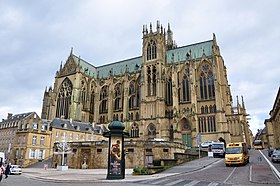 Place Saint-Étienne au pied de la cathédrale | ||
| Situation | ||
|---|---|---|
| Coordonnées | 49° 07′ 13″ nord, 6° 10′ 30″ est | |
| Pays |  France France | |
| Région | Grand Est | |
| Ville | Metz | |
| Quartier(s) | Metz-Centre | |
| Morphologie | ||
| Type | Place | |
| Géolocalisation sur la carte : Lorraine
| ||
modifier  | ||


La place Saint-Étienne est une place de la ville de Metz qui borde la cathédrale Saint-Étienne.
La place Saint-Étienne est construite pour partie sur l'ancienne muraille du haut-empire, cette place surmonte de près de six mètres la Place de Chambre et donnait accès à l'église Notre-dame-de-la-ronde et était le second accès à la cathédrale. Elle était reliée à l'origine par un grand emmarchement prenant toute la largeur de la place.
En 1763, Blondel l'aménage en terrasse, reposant sur des voûtes qui s'avancent en fer à cheval et bordée par deux escaliers. Cette place était bordée par deux corps de bâtiments identiques : à l'Est, les dépendances qui accueille aujourd'hui la DRAC et les bâtiments de France, à l'ouest la nouvelle bibliothèque et un restaurant. Ce dernier bâtiment sera démoli en 1905 afin d'élargir la rue d'Estrées.
Cette place a pris plusieurs noms : place des hauts degré au 14e siècle, place Jotte, puis place du pâté de la cathédrale à cause de sa forme arrondie, le Parapet en 1795 ou durant la période révolutionnaire place Étienne.
 Portail de l’architecture et de l’urbanisme
  Portail de Metz


