Étoile d'Alexandre Permutations | Voir aussi | Menu de navigationmodifierm
Casse-tête mécanique articulé
projets correspondants casse-têtegéométriquetrois dimensionsUSRubik's CubedodécaédriqueMegaminx

Cet article est une ébauche concernant le jeu.
Vous pouvez partager vos connaissances en l’améliorant (comment ?) selon les recommandations des projets correspondants.
.mw-parser-output .entete.jeubackground-image:url("//upload.wikimedia.org/wikipedia/commons/9/90/Picto_infobox_Game.png")
casse-tête
| Auteur | Adam Alexander |
|---|---|
| Date de 1re édition | 1982 |
| Joueur(s) | 1 |
| habileté physique  Non Non | réflexion décision  Oui Oui | générateur de hasard Non | info. compl. et parfaite Oui |
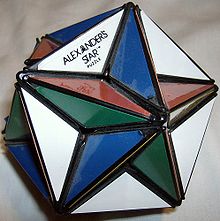
L'Étoile d'Alexandre est un casse-tête géométrique à trois dimensions inventé par le mathématicien américain Adam Alexander en 1982. Elle a été brevetée le 26 mars 1985 (brevet US 4,506,891).
L'Étoile d'Alexandre s'apparente au Rubik's Cube mais est dodécaédrique. Elle est constituée de 30 pièces mobiles et est équivalente aux arêtes du Megaminx. Il est donc possible d'y jouer sur un Megaminx en ignorant les sommets et les centres.
Permutations |
Le nombre de positions différentes pour une Étoile d'Alexandre est de :
30!×215120≈7,24×1034displaystyle frac 30!times 2^15120approx 7,24times 10^34
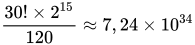
Cela fait exactement 72 431 714 252 715 638 411 621 302 272 000 000 positions différentes.
Voir aussi |
- Grand dodécaèdre

 Portail des jeux


